July 17th 2022
A busy few months at university have finished now and I’m back on the farm again. It’s been lovely to be able to sit under the oak with the sheep again and get some R&R in. They seem pleased to have me back!
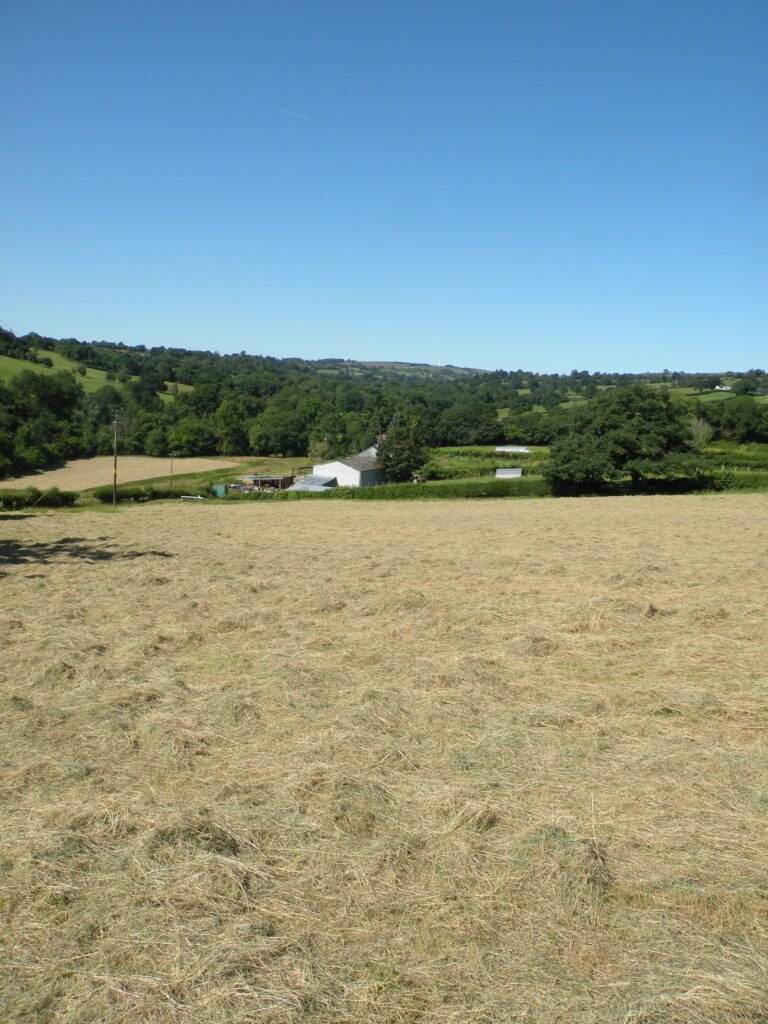
It’s not all been rest though. For one, the past week has been packed full of hay making.
Because of the relatively small number of sheep we have to graze our meadows, and the Hebrideans and Boreray being both small and conservation grazers we tend to have quite a few fields that are ready for hay when the summer comes round. This results in a larger amount of hay than would be easy to move, even if we do have that farmer’s strength now! We’ve had help from friends this time around which made it much easier than it was last year.
With a week of sun forecast the meadows were cut and left to dry. After some spinning by the tedder and the all clear that it was ready to go, Friday saw the tractors come in for raking and baling. We’ve ended up with more than last year – which makes sense as we’ve cut a bit later – and have both large round and smaller square bales. Neighbours helped bring the small squares into the shed, finally finishing about 11pm on Friday, but a great job done (and more hands did make lighter work!) The large bales are on the fields waiting for collection now.
We choose not to fertilise our fields for a number of reasons – firstly because it aids wildflower growth (who would otherwise be outcompeted by overly ferocious grasses), and secondly because it simply isn’t necessary for us when farming on this scale. We don’t have the same pressure to feed hundreds of sheep on our land for food production that others face. This lack of fertilisation doesn’t seem to have hindered the hay production at all – in fact, we have had more this year than we did last year from the same number of fields. Within this meadow cut we have a big variety of species – a number of grasses, creeping buttercups, birdfoot trefoil, clover, oxeye daisies (a first for us!) among others.
One hill is simply too steep to cut for hay, and we have instead left this to grow as it sees fit (for its second year in a row). It’s exciting to see what comes up after the land has been left to rest for a while, and we’ve already seen changes in the flora this year in comparison to growth in areas we cut a year ago. I’m hoping that with time and minimal pressure from sheep we will see some young trees begin to poke over the top of the grasses. It’s an area with a number of very old oaks, so I’ve got my fingers crossed for some newer.